American Exceptionalism. That's Not a Compliment.
The other day, someone on LinkedIn posed the question: If we are to rebuild democracy, who is invited into the room?
That is the wrong question to ask. It is a gatekeeping question. It assumes democracy is a finite resource — a private club where only a few have a say. I am not interested in rebuilding the democracy of old where a system built on stolen land, designed to exclude the very people who built this nation while being denied the basics of life.
American Exceptionalism: The Lie We've Been Sold
We are taught that American exceptionalism means we are the best — the freest, the most advanced, the beacon of democracy — the shining city on a hill. But exceptionalism doesn't mean excellence. Merriam Webster defines exceptionalism as: the belief that a nation, group, or ideology is an exception to a usual rule or trend or is exceptional in relation to others of the same kind. But… when you look at the data, America is exceptional in exactly one way: we are the exception to every standard of human dignity that other wealthy democracies have established.
We are the exception on healthcare. The exception on parental leave. The exception on paid vacation. The exception on worker protections. We are exceptionally cruel in how we treat the most vulnerable, exceptionally efficient at funneling resources upward, and exceptionally committed to calling this freedom.
American exceptionalism isn't about being great. It's about hiding our oppression in plain sight. And to understand why we remain the outlier after 140 years of watching other nations build systems that work, we have to look at the architecture underneath.
To understand where we are going, we have to understand where we really are. The United States is not a progressive society — it's not even as liberal as many citizens have been told. When you look at other industrialized democracies, the United States falls just to the right of center. As an example, Mayor Zohran Mamdani's progressive stance would be considered mainstream in other democracies — here, it's dismissed as radical and threatening to the two-party status quo.
This isn't accidental. Labeling such positions as 'dangerous' serves a purpose: it prevents us from confronting the past and present pain caused by US systems, policies, and daily actions. It would mean admitting that our entire political spectrum — not just the right — is designed for suppression and control. It would mean acknowledging that we have built a system that needs you to internalize scarcity, that resources are thin, and that status, a weak stand in for dignity, is a prize you must win through your race, your sex, or your productivity.
The Blueprint of Suppression
I specifically want to focus on the control of women — the largest oppressed group in the world, comprising approximately half of humanity. This architecture of control was built through centuries of domesticating the most essential labor of human existence. Historically, the skills identified as women's work — the care of the home, the mastery of community relationships, and the shaping of human behavior in children — were rebranded as duties relegated to the lesser sex, rather than essential strategic labor.
The irony is staggering: The patriarchy has long maintained that women are not 'important' enough to make business or political decisions, yet they are the ones solely trusted to shape the very fabric of human behavior. By confining these skills to the private sphere, the system achieved a specific goal: it secured a massive, unpaid labor force to handle the baseline of human needs, while clearing the public square for a transactional model of power.
This is why I think the LinkedIn question — who is invited into the room? — reveals everything wrong with how we think about democracy. We're debating invitations while other nations simply built rooms large enough for everyone.
The Performance of Dignity
Because we have devalued the foundation of care, we treat safety as a reward for productivity. We have built a system focused on specific characteristics to prove someone is human enough to deserve care.
In a system where dignity is tied to productivity, the most vulnerable among us are the first to be discarded. Children and elders are immediately excluded because they are either not productive yet or they are no longer viewed as 'productive' enough. We treat the beginning and the end of life as inconveniences to be managed rather than sacred stages of the human experience. If you aren't generating capital, the fine print of American Exceptionalism says you don't belong.
The Data of a Statistical Outlier
We are told we are the leaders of the First World, but really, we are a statistical outlier — and we always have been. This isn't a recent shift or a temporary aberration. It's the foundation we built on, brick by deliberate brick.
The Historical Pattern in Healthcare
The story of American exceptionalism is written in what we refuse to provide. While Germany established compulsory health insurance for workers in 1883 — over 140 years ago — countries across Europe followed throughout the early 1900s: Austria, Hungary, Norway, Britain, Russia, and the Netherlands all created social insurance systems before World War I even began.
When the United Kingdom created the National Health Service in 1948, guaranteeing healthcare as a right for all residents, we called it socialism. When Canada built universal healthcare starting in 1962, we said it would destroy medical innovation. When Japan established universal coverage in 1961, we looked the other way.
Today, the United States remains the only Organization for Economic Co-operation and Development (OECD) country — the only wealthy industrialized nation on Earth — without universal healthcare. Every other developed economy made this choice decades ago. We are still fighting about it in 2026.
This is 140 years of choosing the same answer: dignity is not a right, it's a reward.
The Missing Support: Parental Leave
When you have a child in any other developed nation, paid time off is a given to care for that child without losing your job or your income.
Thirty-seven out of 38 OECD countries offer paid maternity leave to new mothers. On average, these countries provide 17.3 weeks of leave with wage replacement ranging from 27% to 100% of previous earnings. What does providing the foundation of a healthy life look like elsewhere?
Estonia: 20 weeks of fully paid leave, followed by 62 optional weeks of parental leave. Norway: Parents choose between 49 weeks at 100% pay or 59 weeks at 80% pay. Bulgaria: 410 days — more than 1 year — at 90% of average earnings. Sweden: 480 days of parental leave that can be split between parents.
And the United States? Zero. Not zero weeks of well-paid leave — zero weeks of any federally mandated paid leave whatsoever.
We share this distinction with Papua New Guinea and a small handful of low-income nations. We are the only first-world country that treats the birth of a child as a personal financial crisis rather than a moment deserving of collective support.
The Vacation Gap: Rest as Luxury
Even rest is rationed in America. The European Union guarantees every single worker — regardless of job, regardless of tenure, regardless of income — four weeks of paid vacation as a minimum. Many countries go further:
Austria and France: 25 days of mandatory paid vacation per year. Germany: 24 days minimum (typically 20 for a standard five-day work week). Spain: 25 days plus 14 paid public holidays.
Japan guarantees 10 paid vacation days plus 15 paid holidays. Australia mandates 20 paid days off plus 8 holidays. Mexico, Afghanistan, Thailand, Tanzania — they all guarantee paid vacation in the formal job sector.
Every one of these countries asked the question 'what do humans need?' There was no invitation required — no productivity test to pass, no earning minimum. The room was built with you inside it already.
The United States mandates zero paid vacation days and zero paid holidays at the federal level. We are the only industrialized nation — the only one — that treats rest as something you must earn rather than something you need to be human.
Values and Ideology
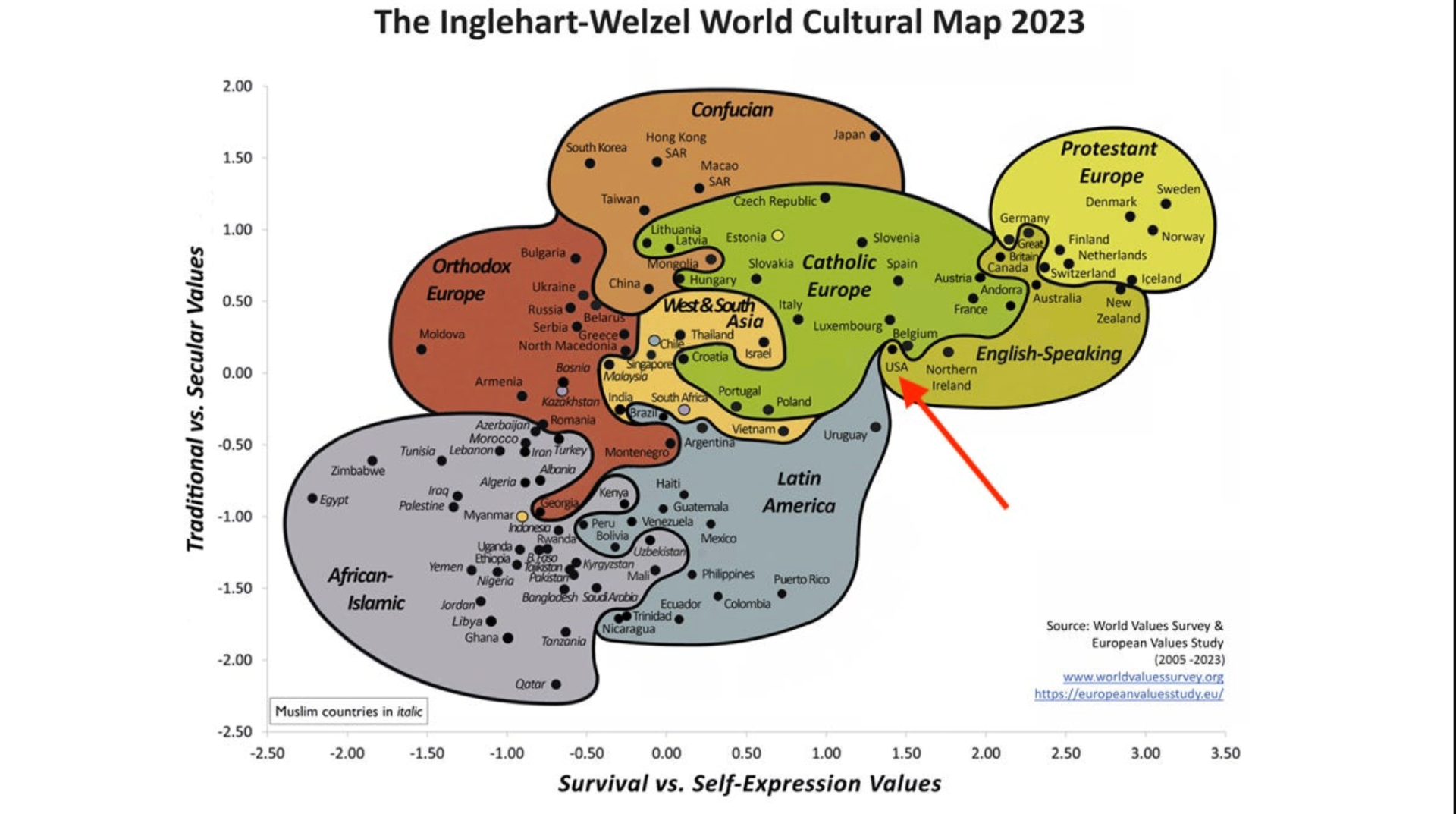
The Inglehart-Welzel Cultural Map — a research project mapping values across societies — reveals why these patterns persist. While our peer nations have moved toward what researchers call Secular-Rational values (where human dignity is treated as a structural baseline), the United States remains anchored in Traditional values (where hierarchy, deference to authority, and earned worth dominate).
What's interesting is that this analysis doesn't revolve around religion versus secularism. It's about whether we believe people deserve a foundation simply for being human, or whether we believe they must prove their worth first.
Pew Research confirms the divide: 58% of Americans prioritize 'freedom from state interference' over guaranteeing that nobody is in need. In Europe, those numbers are flipped — the collective matters more than individual autonomy to accumulate.
The Psychology of Exclusion
This ideological framework is the blueprint for our collective anxiety. When a society invests in the upward trajectory rather than the communal support system, it changes how we see ourselves and each other. It makes the question 'Who deserves help?' feel normal instead of obscene.
At the beginning of this article I mentioned the post about who is invited to the conversation to rebuild democracy. The word 'invited' is the exemplification of this broken system. The question 'Who is invited into the room?' forces us to look inward: If I wasn't invited, what is wrong with me? This is the brilliance of a suppressive system. It uses the 'invitation' to turn a systemic denial of rights into a personal failure.
The Existing Baseline
We don't need to imagine a different way; we only need to look outside the US at systems that already function this way. Whether it is the secular-rational foundation of social democracies or communal theory, the architecture is the same: the system doesn't wait for you to be productive to grant you safety.
In these models, humans aren't measured against a hierarchy of exceptional traits — traits that must be developed to survive within the construct of US systems. Politicians stop trading favors at the federal level to decide which group 'deserves' a safety net. Instead, there is support for everyone, equally.
Being human is defined as the baseline for dignity. Full stop.
The Matriarchal Reality
Matriarchies consider the human.
When most people hear matriarchy, they imagine a simple gender swap — women holding power instead of men, the same hierarchical system with different faces at the top. That misunderstanding is itself a product of patriarchal thinking, which can only conceive of power as domination.
Matriarchy isn't about who rules or invites: it's about what we value as the foundation of society.
A matriarchal system is organized around care as the primary infrastructure. Not care as charity or something you earn, but care as the baseline from which all other human activity becomes possible. It asks: What do people need to survive and thrive? And then we know what to build into those systems first, before asking anyone to prove their worth.
The distinction is structural
Patriarchy operates from scarcity and competition disguised as opportunity. It asks: Who deserves resources? Who has earned safety? Who gets access? It assumes there isn't enough, so someone must be denied. Power flows upward, and those at the bottom must fight for scraps while serving those above.
Matriarchal Systems in Practice: Universal healthcare — your body's needs don't require justification. Paid parental leave — caring for new life is recognized as essential labor. Free or subsidized childcare — raising the next generation is collective work. Strong labor protections — people shouldn't be disposable. Housing as a right — shelter is a prerequisite for participating in society. Education without debt — learning shouldn't require decades of repayment.
These are the foundation of a functioning, inclusive society. And every wealthy democracy except the United States has built some version of this foundation because they've recognized that people who aren't struggling to survive contribute more to society, not less.
Matriarchal thinking applied to our economy would mean universal healthcare. Applied to our workplaces would mean paid leave and labor protections. Applied to our justice system would mean restorative practices instead of punishment. Applied to our politics would mean consensus-building instead of winner-takes-all. The framework scales.
This is how a matriarchy works.
It is not a new or experimental theory. When we look at modern matriarchal studies — specifically the work of Dr. Heide Goettner-Abendroth — we see that these systems are defined by specific socio-economic anchors that prioritize the health of the community over the accumulation of the individual:
Consensus, Not Command: Decisions are made through collective responsibility. There is no gatekeeper. The Economy of Needs: Resources are distributed based on who needs them — beginning with children and elders — rather than who 'earned' them through capital production. The Baseline of Land/Home: Historically, matriarchal societies (like the Haudenosaunee or the Mosuo) viewed resources as collective assets. Your humanity was never up for debate based on your bank account.
It is a shift from a winner-take-all hierarchy to an architecture of collective care. It is the transition from a society that suppresses to one that expands.
The Fear of Care
The resistance to matriarchal systems in America isn't about cost — we're the wealthiest nation on Earth. It's ideological. We've been taught that requiring people to earn their dignity creates motivation. That struggle builds character. That if we provide support, people will become lazy, dependent, ungrateful.
But the data proves otherwise. Countries with strong social support systems don't have populations of unmotivated freeloaders. They have higher rates of entrepreneurship, innovation, education, and reported happiness. People freed from survival mode do more, not less.
The fear is about control. Patriarchal systems require desperation to function — desperate workers accept worse conditions, desperate people don't organize, desperate communities turn on each other instead of looking up at who's hoarding resources.
Matriarchal systems remove that desperation. And that's what makes them threatening to those who benefit from the current structure.
If the old system didn't work for you, it's because it was never designed to hold you. It was designed to keep you at the door, waiting for an invitation that was never intended to come.
The question was never 'who gets invited?' The question is: why are we still asking permission to build what every other wealthy nation already has?